
 CONTACTMENUCONTACTMENU
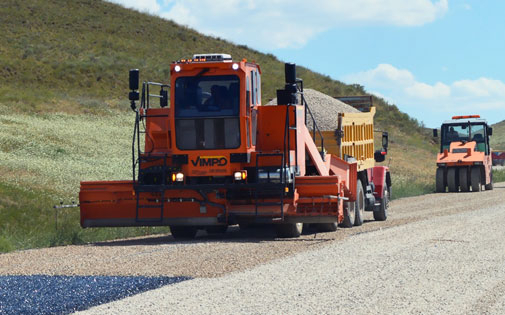
Building a road takes far more than a paver and a roller. From clearing the site to sealing the final surface, every stage of a road project relies on specialised machines, and the right equipment at each stage determines how fast, how economically and how durably the road is built.
This guide explains the 20 most used machines in road construction and maintenance, grouped by the stage of the project in which they work.
Road construction machines are the equipment used to build, resurface and maintain roads. They range from earthmoving machines that prepare the road bed, to plants that produce asphalt and bitumen, paving machines that lay the pavement layers and maintenance machines that keep the surface in service.
| Project Stage | Machines |
|---|---|
| 1. Earthworks and site preparation | Excavator, bulldozer, motor grader, wheel loader, dump truck |
| 2. Base and sub-base | Road roller, soil stabiliser |
| 3. Material production and storage | Asphalt plant, bitumen emulsion plant, polymer modified bitumen plant, bitumen storage and heating systems |
| 4. Paving | Asphalt distributor, asphalt paver, cold planer |
| 5. Surface treatment and maintenance | Chip spreader, combi chip spreader, micro-surfacing paver, crack router and crack sealing machine, asphalt thermobox, road sweeper |
Every road starts with earthworks: removing unsuitable soil, cutting and filling to the design levels and shaping the road bed.
Excavators dig, load and move material with a boom, arm and bucket. In road construction they are used for cutting slopes, digging drainage ditches and culverts, removing unsuitable soil and loading trucks. Tracked excavators are preferred on rough terrain, while wheeled excavators move faster between work points in urban areas.
Bulldozers push large volumes of soil and rock with a front blade. They clear vegetation, strip topsoil and carry out rough levelling in cut-and-fill operations. A rear ripper allows them to break up hard ground before excavation.
Motor graders use a long, adjustable blade to bring the road bed and base layers to the exact level, slope and camber required by the design. They are also used for shaping ditches and for maintaining unpaved roads. The quality of grading directly affects the evenness of the final surface.
Wheel loaders load aggregate, soil and other bulk materials into trucks, plant hoppers and machines. On road projects they work at quarries, stockpiles and asphalt plants, and they feed aggregate to chip spreaders during chip sealing.
Dump trucks carry excavated soil, aggregate and hot mix asphalt between the plant, the stockpile and the site. Some chip spreaders are mounted directly on the tipper of a dump truck, turning it into a spreading machine.
The strength of a road comes from the layers beneath the surface. These layers must be compacted and, where necessary, stabilised to carry traffic loads for decades.
Road rollers compact soil, aggregate base and asphalt to the density required by the specification. Different types are used for different materials: smooth drum and padfoot rollers for soil, vibratory rollers for granular layers and asphalt, and pneumatic-tyred rollers for asphalt finishing and chip sealing, where they embed chips without crushing them.
Soil stabilisers mix cement, lime or bitumen emulsion into weak soil or existing road material to improve its strength. This allows on-site material to be reused instead of being replaced. Stabilised material can also be produced at a central cold mix plant, where aggregate, water and binder are mixed in controlled proportions.
Asphalt pavements and surface treatments are only as good as the materials they are made of. These plants and systems produce and store the asphalt and bitumen products used on site.
Asphalt plants heat and dry aggregates and mix them with hot bitumen to produce hot mix asphalt. Batch plants produce asphalt in separate batches and allow frequent recipe changes, while drum plants produce asphalt continuously for high-volume projects. Clean aggregate is essential for good bitumen adhesion; an aggregate washing plant removes dust and clay before the aggregate reaches the plant.
Bitumen emulsion plants produce bitumen emulsion, a mixture of bitumen, water and an emulsifier. Because it can be applied at much lower temperatures than hot bitumen, emulsion is widely used for tack coats, chip seals, micro-surfacing, slurry seals and cold mix. Producing their own emulsion allows road authorities and contractors to control quality and reduce costs.

Polymer modified bitumen (PMB) plants blend polymers into bitumen to improve its elasticity and its resistance to rutting, cracking and ageing. PMB is used on motorways, airports, heavy-traffic roads and in regions with extreme temperatures.
Bitumen must be stored hot and delivered to the plant or site without interruption. Bitumen tanks and thermal oil heaters keep bitumen at working temperature at the plant, bitumen melting systems process bitumen delivered in drums or bags, and mobile bitumen tanks carry hot bitumen to the site.
Paving machines place the asphalt layers that carry the traffic, and prepare the existing surface when a road is resurfaced.
Asphalt distributors spray bitumen or bitumen emulsion onto the road at a precise rate per square metre. They apply prime coat on new granular bases, tack coat between asphalt layers so that they bond, and the binder for chip seals. Fully automatic proportional distributors keep the application rate constant regardless of vehicle speed, preventing both poor bonding and binder bleeding. Learn more in our guide: what is an asphalt distributor and how does it work.

Asphalt pavers receive hot mix asphalt from trucks and lay it in an even layer at the required width and thickness. The screed at the rear levels and pre-compacts the mat, which is then compacted by rollers. Tracked pavers provide high traction on wide projects, while wheeled pavers are faster to move between sites.
Cold planers, also known as milling machines, remove the damaged top layer of an asphalt road to a set depth. This restores the levels before resurfacing and produces reclaimed asphalt that can be recycled into new mixes.
Most of a road's life is spent in service, and well-timed maintenance is far cheaper than reconstruction. These machines renew the surface, seal it against water and repair damage before it spreads. For an overview of the methods, see our guide to road maintenance methods.
Chip spreaders spread a single, even layer of aggregate chips over freshly sprayed binder in chip sealing. Self-propelled chip spreaders receive chips from trucks and spread them across a wide width at a constant rate. For smaller jobs, a dump truck chip spreader is mounted on the truck's tipper. Read more about the process in what is chip sealing and how is it done.
A combi chip spreader combines the asphalt distributor and the chip spreader in a single vehicle. Because the chips are spread immediately after the binder is sprayed, chip retention improves, and fewer vehicles and operators are needed on site.
The micro-surfacing paver mixes polymer-modified bitumen emulsion, fine aggregate, filler, water and additives on board and lays them as a thin cold layer in a single pass. Micro-surfacing restores surface texture, seals minor cracks and fills shallow ruts, and the road can usually be reopened to traffic quickly.
Cracks let water into the pavement and are the starting point of most potholes. The asphalt crack router cuts a clean reservoir along the crack, and the crack filling machine fills it with hot rubberised sealant. Crack sealing is one of the most cost-effective preventive maintenance treatments.
The asphalt thermobox is a heated, insulated container that keeps hot mix asphalt at working temperature for long periods. It allows maintenance crews to carry out permanent hot-mix pothole repairs across many locations in a day, and even in cold weather, instead of temporary cold-mix patches.
The road sweeper removes dust and loose material before surface treatments, so that binders bond properly to the road. After chip sealing, it collects loose chips that could damage vehicles.
The right equipment depends on the type of work, the scale of the project and local conditions. When choosing road construction and maintenance machines, consider the following factors:
The main machines used in road construction are excavators, bulldozers, motor graders, wheel loaders and dump trucks for earthworks; road rollers and soil stabilisers for base layers; asphalt plants for material production; and asphalt distributors, asphalt pavers and rollers for paving.
Road maintenance mainly uses asphalt distributors, chip spreaders, micro-surfacing pavers, crack routers and crack sealing machines, asphalt thermoboxes for pothole repair, cold planers and road sweepers.
An asphalt distributor sprays liquid bitumen or bitumen emulsion onto the road, for example as a tack coat or as the binder for a chip seal. An asphalt paver lays hot mix asphalt, a mixture of bitumen and aggregate, as a structural layer several centimetres thick.
Chip sealing requires an asphalt distributor to spray the binder, a chip spreader to spread the chips, a pneumatic-tyred roller to embed them and a road sweeper to remove loose chips. A combi chip spreader performs both spraying and spreading in one machine.
Founded in Ankara in 1997, Vimpo manufactures road construction and maintenance machines and bitumen processing plants, with production facilities in Ankara, Turkey, and Pune, India. Vimpo’s range covers asphalt distributors, chip spreaders, combi chip spreaders, micro-surfacing pavers, crack sealing machines, asphalt thermoboxes and road sweepers, as well as bitumen emulsion plants, PMB plants and bitumen storage systems. Vimpo developed the VCS 5400, Turkey’s first self-propelled chip spreader, and today works with partners and customers in more than 20 countries.
Explore the full range on our products page or contact our team to find the right equipment for your project.
We have all road construction machines. Find the product you need.
ALL PRODUCTS
Vimpo Maschinen GmbH Gebäude P-F-377 Leopoldstr. 2-8 32051 Herford
+49 1516 8459644
Mail:sales.eu@vimpo.com
Vimpo Machine Pvt. Ltd. (Factory)
Plot No. PAP-160, Village - Shinde, TAL-Khed.Dist- Pune, Chakan phase-2 Maharashtra-410501
+91 6359-818748
Venta-Tech LLC
sale@venta-tech.com
+380671229797 Whatsapp/Telegram
АСТРА
Krasnoshkolnaya Embankment 2, Office 22, 61050 Kharkiv
+380577329505
TREMCO Transport Equipments Manufacturing Company
Sabhan, Block 11, Building 224 Sabhan, Block 9, Building 100
+965 9720 6090
EAST EG ENGINEERING AND SERVICES TECHNOLOGY SAE
30 ST 276 New Maadi, Cairo 11742, Egypt.
Tel: +20 2 2519 3383 |Ext 139 Fax: +20 2 2519 3381

 Vimpo Road Construction MachinesVimpo Makine A.Ş.
